

The IB mission
The International Baccalaureate aims to develop inquiring, knowledgeable and caring young people who help to create a better and more peaceful world through intercultural understanding and respect.
To this end the organization works with schools, governments and international organizations to develop challenging programmes of international education and rigorous assessment.
These programmes encourage students across the world to become active, compassionate and lifelong learners who understand that other people, with their differences, can also be right.
JBS is a fully authorised IB World School, certified to offer the IB Primary Years Programme (PYP), the IB Middle Years Programme (MYP), the Diploma Programme (DP) and the Career-related Programme (CP) for students from Pre-KG to Grade 12.
1,950,000
Around the world
5,500
Schools across the globe
160+
Countries

How does the IB
define ‘international
education’?
The IB chooses to define ‘international education’
according to the following criteria:
- 01 Developing citizens of the world in relation to culture, language and learning to live together
- 02 Building and reinforcing students’ sense of identity and cultural awareness
- 03 Fostering students’ recognition and development of universal human values
- 04 Stimulating curiosity and inquiry in order to foster a spirit of discovery and enjoyment of learning
- 05 Equipping students with the skills to learn and acquire knowledge, individually or collaboratively, and to apply these skills and knowledge accordingly across a broad range of areas
- 06 Providing international content while responding to local requirements and interests
- 07 Encouraging diversity and flexibility in teaching methods
- 08 Providing appropriate forms of assessment and international benchmarking
- 09 All four programmes are committed to the development of students according to the IB learner profile
The profile aims to develop learners who are:
IBO Global Website-

Inquirers
-

Knowledgeable
-

Thinkers
-

Communicators
-

Principled
-

Open-Minded
-

Caring
-

Risk-Takers
-

Balanced
-

Reflective

IB Diploma Programme (DP)
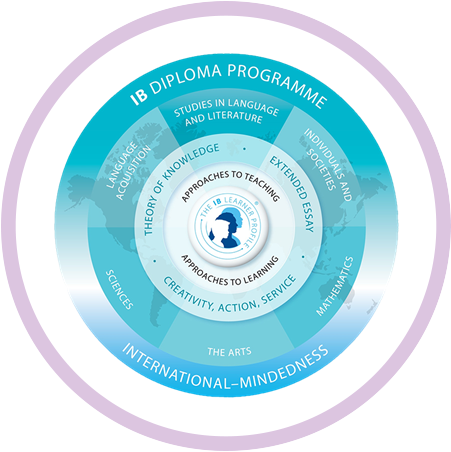
The Diploma Programme Core The Extended Essay asks students to engage in independent research through an in-depth study of a question relating to one of the DP subjects they are studying. The world studies extended essay option allows students to focus on a topic of global significance, which they examine through the lens of at least two DP projects.
The Theory of Knowledge develops a coherent approach to learning that unifies the academic disciplines. In this course on critical thinking, students inquire into the nature of knowing and deepen their understanding of knowledge as a human construction.
Creativity, Activity, Service (CAS) involves students in a range of activities alongside their academic studies throughout the Diploma Programme. Creativity encourages students to engage in the arts and creative thinking. Activity seeks to develop a healthy lifestyle through physical activity. Service with the community offers a vehicle for a new learning with academic value. The three strands of CAS enhance students’ personal and interpersonal development through experiential learning and enable journeys of self-discovery.
Each Subject Group offers Different Courses
and students must choose
One Subject for each
of the first five groups and either an Arts subject or second subject from groups 1 to 5.
Sciences
Language and Literature
Individuals and Societies
The Arts
Mathematics
Language Acquisition
The IB Career-related Programme (CP)
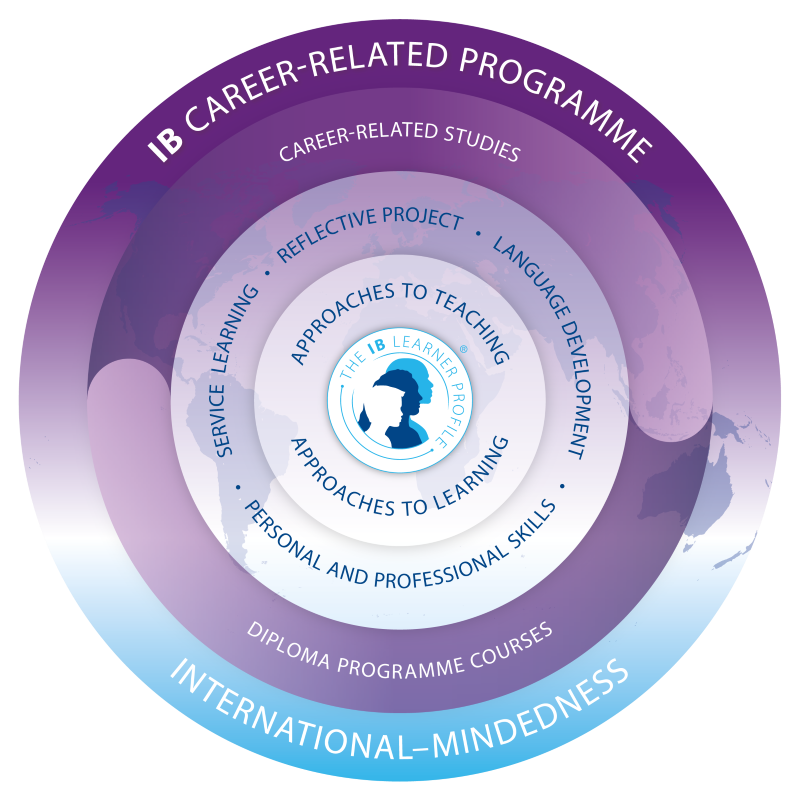
The International Baccalaureate (IB) Career-related Programme (CP) is a programme specifically developed for students who wish to engage in career-related learning. CP students engage with a rigorous study programme that genuinely interests them while gaining transferable and lifelong skills.
CP students follow a programme that combines a career-related study comprising of the highly regarded Pearson BTEC Level 3 Foundation Diploma in Business, alongside a minimum of two courses from the IB Diploma Programme (DP). In addition, students study a unique CP core with includes language development, personal and professional skill development and a reflective project which focuses upon exploring ethical issues linked to the career-related study.
The CP develops students to be:
- Academically strong
- Skilled in a practical field
- Critical and ethical thinkers
- Self-directed
- Collaborative
- Resilient and determined
- Confident and assured
- Caring and reflective
- Inquirers
For CP students, DP courses provide the theoretical underpinning and academic rigour of the programme; the career-related study further supports the programme’s academic strength and provides practical, real-world approaches to learning; and the CP core helps them to develop skills and competencies required for lifelong learning.
Why study the IB Career-related Programme?
The CP helps students to prepare for effective participation in life, fostering attitudes and habits of mind that allow them to become lifelong learners and to get involved in learning that develops their capacity and will to make a positive difference. The programme promotes development of skills and encourages students to take responsibility for their own actions, encouraging high levels of self-esteem through meaningful achievements.
Who is the CP for?
The CP was specifically developed for students who wish to engage in career-related learning while gaining transferable and lifelong skills in applied knowledge, critical thinking, communication, and cross-cultural engagement.

Why the Diploma Programme?
Students take written examinations at the end of the DP, which are marked by external IB examiners. Students also complete assessment tasks in the school, which are either initially marked by teachers and then moderated by external moderators or sent directly to external examiners.
The marks awarded for each course range from 1 (lowest) to 7 (highest). Students can also be awarded up to three additional points for their combined results on Theory of Knowledge and the Extended Essay. The Diploma is awarded to students who gain at least 24 points, subject to certain minimum levels of performance across the whole programme and to satisfactory participation in the Creativity, Action, Service requirement. The highest total that a DP student can be awarded is 45 points.
Assessment
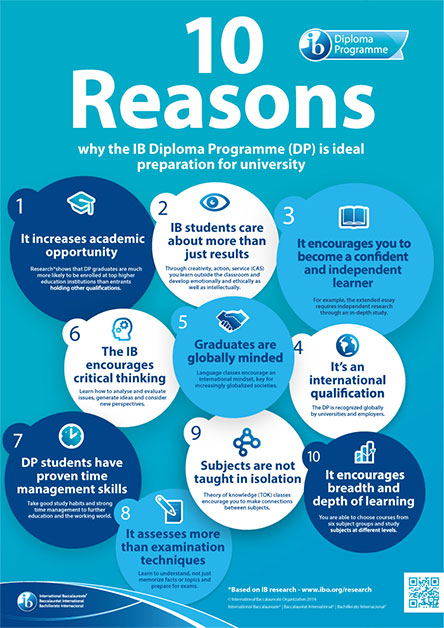
The DP prepares students for effective participation in a rapidly evolving and increasingly global society as they:
- Develop physically, intellectually, emotionally and ethically
- Acquire breadth and depth of knowledge and understanding, studying courses from 6 subject groups
- Develop the skills and a positive attitude toward learning that will prepare them for higher education
- Study at least two languages and increase the understanding of cultures, including their own
- Make connections across traditional academic disciplines and explore the nature of knowledge through the programme’s unique theory of knowledge course
- Undertake in-depth research into an area of interest through the lens of one or more academic disciplines in the extended essay
- Enhance their personal and interpersonal development through creativity, action and service
To find out more about the DP, please either visit www.ibo.org/dp or come and meet our DP Coordinator at JBS.
1. IB Primary Years
The International Baccalaureate’s Primary Years Programme (PYP) is designed to build upon the natural curiosity of the child. Intended for children ages 3 to 12, the programme focuses on the development of the whole child as an inquirer, both in the classroom and in the world outside. Students participate in four to six ‘Units of Inquiry‘ per year.
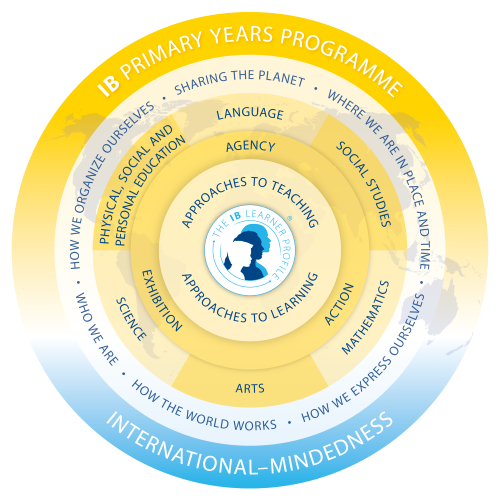
To ensure that children acquire a broad base of knowledge, the Units of Inquiry are developed under six ‘organising themes’.
- Who We Are
- Where We Are in Place and Time
- How the World Works
- How We Organise Ourselves
- How We Express Ourselves
- Sharing the Planet
The six subject areas of Language, Social Studies, Personal, Social and Physical Education, Mathematics, Science and Technology and the Arts are woven into the Units of Inquiry to provide a trans-disciplinary approach to learning. In the last year of the PYP, students participate in the PYP Exhibition, showcasing their development through their engagement with the PYP.
The Features of IB PYP are:
- Addresses students’ academic, social and emotional well-being
- Encourages students to develop independence and to take responsibility for their own learning
- Supports students’ efforts to gain understanding of the world and to function comfortably within it
- Helps students establish personal values as a foundation upon which international-mindedness will develop and flourish.
The PYP focuses on the development of the whole child as an inquirer, both in the classroom and in the world outside.
The PYP is the first of four IB programmes of education. It gives students an excellent foundation for the IB’s other programmes, the MYP, DP and IBCP.
To find out more about the PYP, please either visit www.ibo.org/pyp or come and meet our PYP Coordinator at JBS.
2. IB Middle Years
After finishing the initial phase, students at JBS enter the IB Middle Years Programme (MYP), which prepares them for the IB Diploma Programme or IB Career-related Programme. The MYP is offered from Grade 6 through Grade 10 (students aged 11 to 16). The MYP aims to help students develop their personal understanding, their emerging sense of self and responsibility in their community. Our MYP teachers organize the curriculum with appropriate attention to:
- Teaching and learning in context. Students learn best when their learning experiences have context and are connected to their lives and the world that they have experienced. Using global contexts, MYP students explore human identity, global challenges and what it means to be internationally minded.
- Conceptual understanding. Concepts are big ideas that have relevance within specific disciplines and across subjectareas. MYP students use concepts as a vehicle to inquire into issues and ideas of personal, local and global significance and examine knowledge holistically.
- Approaches to learning (ATL). A unifying thread throughout all MYP subject groups, approaches to learning provide the foundation for independent learning and encourage the application of their knowledge and skills in unfamiliar contexts. Developing and applying these skills help students learn how to learn.
- Service as action (community service). Action (learning by doing and experiencing) and service have always been shared values of the IB community. Students take action when they apply what they are learning in the classroom and beyond. IB learners strive to be caring members of the community who demonstrate a commitment to service—making a positive difference to the lives of others and to the environment. Service as action is an integral part of the programme, especially in the MYP community project.
- Language and identity. IB Middle Years Programme students are required to learn at least two languages (language of instruction and additional language of choice). Learning to communicate in a variety of ways is fundamental to their development of intercultural understanding and crucial to their identity affirmation.
It provides a framework of learning that encourages students to become creative, critical and reflective thinkers. The MYP emphasizes intellectual challenge, encouraging students to make connections between their studies in traditional subjects and to the real world. It fosters the development of skills for communication, intercultural understanding and global engagement, qualities that are essential for life in the 21st century.
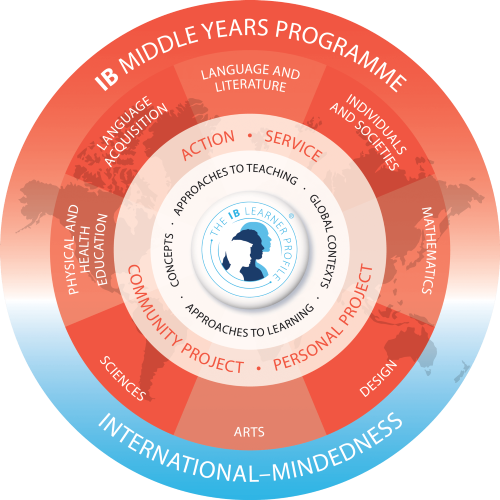
The MYP Programme consists of eight subject groups integrated through five interactive areas providing global contexts for learning.
Students are required to study at least two languages (as part of their multilingual profile), humanities, sciences, mathematics, arts, physical education and technology. In their final year students will also undertake an independent personal project to demonstrate the development of their skills and understanding.
Teachers then break down the eight subjects into areas of interaction.
Research shows that students participating in the IB Middle Years Programme:
- Build confidence in managing their own learning
- Learn by doing, connecting the classroom to the larger world
- Outperform non-IB students in critical academic skills
- Consistently have greater success in IB Diploma Programme examinations
- Thrive in positive school cultures where they are engaged and motivated to excel
- Develop an understanding of global challenges and a commitment to act as responsible citizens
The MYP was revised in September 2014 to provide a more rigorous and highly flexible framework that powerfully integrates with local educational requirements.
To find out more about the MYP, please visit www.ibo.org/myp .
The JBS experience is truly transformational. Each day, our students are
inspired to seek knowledge, believe in themselves and nurture the values
that will allow them to lead happy, fulfilling lives.